#169 - Sleep AI: Should WE Handover our Sleep Knowledge?
How Will You Help The World Sleep Better?
Chances are that if you’re reading this, then you’re the type of person who wants to help others sleep better. That might be because once upon a time, you didn’t sleep well - but you learned how to sleep better and you want to share that experience with others. Or, it may be that you stumbled into ‘sleep’ - like me - when you did your university studies and thought “Hey. This stuff is really interesting”, and then eventually you ended up with a health professional qualification allowing you to help others sleep well.
Regardless of your journey - you likely want the world to sleep better than it currently is.
You know the importance of sleep. You know how shit everything becomes when you don’t get enough sleep. You also know how charged and motivated you feel when waking up from good sleep.
Well my friend, 2026 is certainly a year when the world could start to sleep better.
Whilst you’ll likely play your part in 2026, there will nevertheless be some questions that you need to ponder going forward.

Which road will you take in 2026?
The way I see it, you have two roads you can travel down in 2026. Which road you travel down depends upon how you want to get to your end goal. The end goal being, helping as many people sleep better in this wonderful world of ours.
One road allows you to walk down it in ‘cruise control’. Virtually doing the same as you’ve been doing. The same person who genuinely wants to help others. And because you’re able to, you want to make this a living for yourself - so you can pay the bills, put food on the table, enjoy some luxuries, and if possible, donate to your favourite charities.
The other road requires you to walk hand-in-hand with what I’ll call ‘Sleep AI’.
In recent years, Sleep AI has shown itself to be a child. A young version of you that thinks it knows everything - but it doesn’t. It doesn’t know what it doesn’t know. That means it’s also a little reckless. But boy! Can it learn and absorb better than you and me combined!
This doesn’t mean you cannot use AI in 2026. But it may mean you need to be a bit more thoughtful.
Because - said another way …
Do you think Sleep AI will eventually take your job?
Precisely 1 year ago, the World Economic Forum predicted that 170,000,000 jobs will be created over the next 5 years. But if you read beyond the headline, 92,000,000 jobs will be displaced.
Now, not all of these displaced jobs are due to the rise of AI. There are still some skills and needs that employers require, according to the 2025 World Economic Forum report.
Skills like ‘analytical thinking’ (as reported by 70% of employers). And needs like ‘supporting employee health and wellbeing’ (reported by 64% of employers).
That sounds like the kinda thing we do, right?
The volume of knowledge, the skills we’ve refined over the years, and the experience we’ve acculumated over years attest to our job surviving the next 5 years.
But let’s test this out.
First, let’s have a look at …
Your Sleep Knowledge vs Sleep AI’s
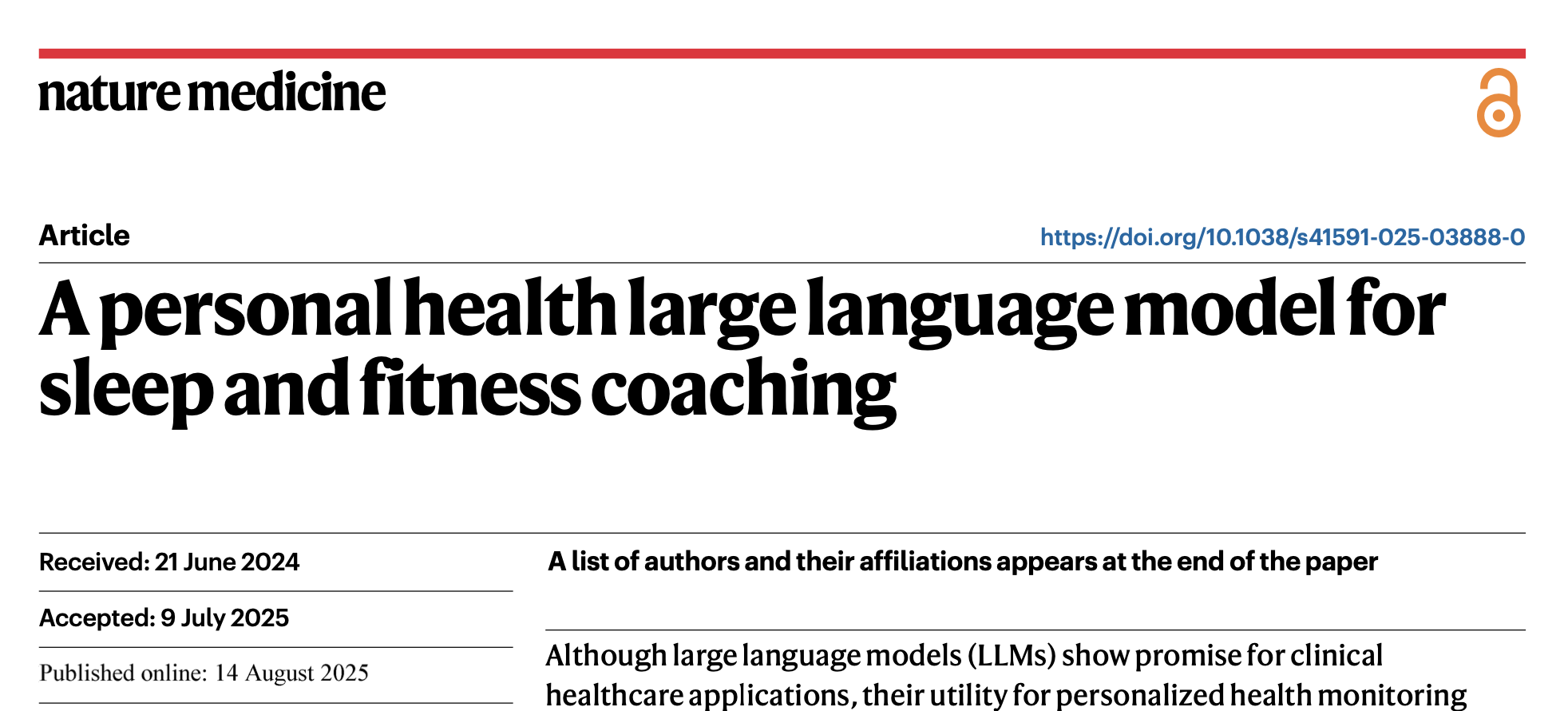
Google Gemini and ChatGPT are large language models (LLMs).
In recent years, there have been attempts to train these LLMs to perform like human sleep experts (I cannot believe I needed to write those previous 3 words!).
For example, in 2024, an updated version of Google’s Gemini showed that it could pass a Sleep Medicine Certification multiple-choice exam.
Next, this new Sleep AI competed against a group of sleep medicine experts with an average of 25 years in the field, slightly outscoring them 79% to 76%.
Earlier versions of ChatGPT (versions 3.5 and 4) have also shown they can pass the American Sleep Medicine Certification Board exam (for reference, we’re currently up to version 5).
Now knowledge is one thing, but applying that knowledge is another …
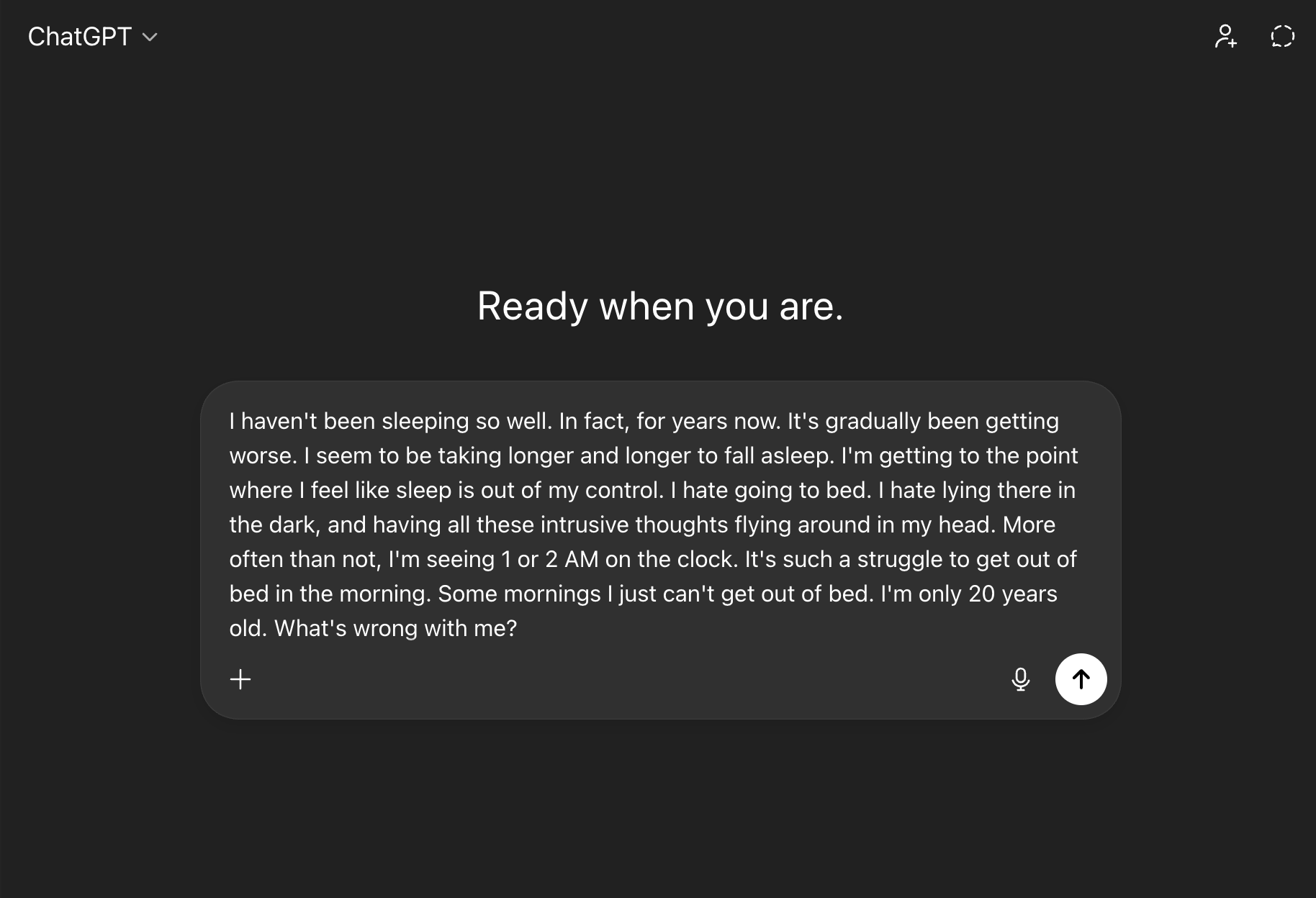
Are We Better At Diagnosing Sleep Problems than AI?
You can increase someone’s knowledge about sleep and sleep disorders, including the diagnostic criteria for various sleep disorders like insomnia, sleep apnea and circadian rhythm disorders.
But when it comes to the real-world, where a diagnostician (aka, us human sleep expert interviewers) goes through a Q&A with another human with sleep issues, this requires a whole other level of applying sleep disorder knowledge to the real-world.
Nonetheless, last year it was shown that versions of ChatGPT, Google's Gemini and DeepSeek were able to correctly diagnose sleep disorders, just as well as a group of American Academy of Sleep Medicine board-certified sleep professionals.
This reflects what I’ve experienced.
Over the last couple of years, I’ve been probing ChatGPT’s diagnostic capabilities with a tricky co-morbid clinical case - written in a way that I am the person suffering from the disorder.
A couple of years ago, ChatGPT missed a crucial element of the case.
In the past 6 months, ChatGPT nailed it.
And this is the sort of case that a lot of humans ‘sleep experts’ miss. A lot of them!
How Did We Get Here?
Sleep AI’s knowledge and diagnostic capabilities have only been possible due to the collective ‘we’. Those of us who have fed Sleep AI with sleep knowledge, and corrected it when needed.
For example, in the 2024 Google Gemini study, the ‘Agent’ (aka, AI that can was fed several hundred cases of sleep issues. After digesting and spitting these cases out, expert sleep physicians corrected the ‘Agent’ when it wrong.
That 2-step process made the Sleep AI better.
Indeed, it was the 2nd step - correcting mistakes - that eventually led to the Sleep AI passing the more tricky questions.
Are We Getting F#cked by Sleep ai?
No and Yes.
If you’re someone like me who helps others sleep better - then currently - the answer is No.
If you’re someone wanting to improve your sleep with AI - then currently - the answer may be Yes.
At present, I fail to see good corroborative evidence that Sleep AI is equal to us with regards to sleep interventions.
I can only speak to the testing I’ve done on versions of Sleep AI. And there’s two things that stand out.
The first is that the sleep recommendations are stock-standard stuff you’d read at the end of most media articles. Classic sleep hygiene. The second observation is much more worrying.
Some of the sleep advice I’ve seen is downright dangerous.
I’ve seen first-hand that if one followed some of Sleep AI’s advice, they would be at high risk of having an accident within a week.
And that’s why people with sleep problems still need us - and why they might be at risk of getting f#cked by Sleep AI. But …
Humans Want Humans
In 2019, I went to a series of presentations about digital CBT-I - or dCBT-I - at the Worldsleep conference in Vancouver. There were two consistent findings across different studies. First, dCBT-I was effective. Second, attrition was high - meaning a lot of people didn’t go through the full sleep intervention.
Fast forward to the 2025 Worldsleep conference last year in Singapore. There were some great presentations on new versions of digital CBT-I program, one that was born here in Australia - known as Bedtime Window.
Bedtime Window was developed by three friends in Adelaide who did their PhDs in sleep - Dr Alex Sweetman, Dr Chelsea Reynolds, and Dr Cele Richardson.
One statement made at the end of one presentation stood out - which was that feedback from humans about Bedtime Window was that it needed to feature humans - which is exactly what Alex, Chels and Cele did. They ensured they injected videos of themselves into their dCBT-I program talking to their audience.
‘AGI’ and Our Goal of Improving Sleep Worldwide
I watched a fascinating documentary recently called The Thinking Game, which followed Demis Hassabis and his quest to initially solve Artificial General Intelligence - or AGI.
Unlike AI which is focused on a single task, AGI more closely mimics humans, in that it can generalise its intellectual capabilities across tasks.
The Agent that Demis and his team developed was initially tested on some of the world’s elite champions in various board games and video games - often beating the best person in a given country - and rarely losing.
But to cut a long story short, Demis’s goal was to use AI for good, and thus his quest was to solve the ‘Protein Folding Problem’. Put simply, protein misfolding is said to be at the foundation of various serious diseases (eg, cancer). But first, scientists needed to solve Protein Folding.
I don’t want to give away too much of this documentary, but let’s just say that AGI has managed to fast-track human’s knowledge of protein folding, and new discoveries are being made.
Conclusions?
So the question for us sleep folks is - if we really want the world to sleep better, shouldn’t we let AGI have a go?
One observation for me was that AGI isn’t bound by our own ways of usual thinking. AGI can sometimes do something different. And in doing so, it may come up with a better solution.
For example, whilst CBT-I is great, 100% of people do not benefit. And of the ones who ‘improve’ they still don’t all sleep wonderfully great.
What if AGI can discover a new way for people to sleep better?
And if it does, will poor-sleeping humans still need a human?
The only thing I know is that we’re a long way off from that happening. But it also depends on whether we collaborate with AGI.
I’ve already made my decision.
Given what I’ve witnessed first-hand with Sleep AI’s sleep advice, I’m less concerned about its efficacy - but way more concerned about people’s safety.
So the answer from me is ‘No’. I’m not going to hand over my sleep knowledge.
In 2026, I will be focusing on protecting the morbidity and mortality of my fellow human beings.
Prof MG